By Elna Seabrooks
Staff Writer
HOULTON — When Gov. John Baldacci signed an executive order last month to provide for improved relationships between Maine and tribal governments, the hope may have been to usher in a new era of understanding whereby sovereign entities will sit down across the table from each other to discuss mutual concerns and interests. Houlton Pioneer Times Photo/Elna Seabrooks
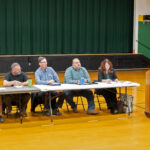
TRIBAL LEADERSHIP — At a meeting last year, Chief Brenda Commander spoke to representatives of the Maine Indian Tribal-State Commmission. At left is Paul Bisulca, then chairman of the group.
Although the governor’s office declined admitting to or commenting on any strain between the state and tribal leaders, some Native Americans said communication and cooperation with the state has constantly encountered problems.
Maine Indian Tribal-State Commission (MITSC) Executive Director John Dieffenbacher-Krall said when a state agency makes a decision, “too often tribal leaders are treated as just another interest group making demands on state government.”
Tribes are sovereign entities
Dieffenbacher-Krall said Native American chiefs “insist on a government-to-government relationship. It’s not like the local Kiwanis Club making an appeal to the state legislature. This is another sovereign government and they want to be treated that way. That’s appropriate.”
He pointed to one recent example of not consulting with tribal leadership “that will affect Wabanaki children due to tuition changes in waivers and complicated financial-aid forms. The chiefs should have been consulted and offered alternatives.”
Dieffenbacher-Krall said the May 1 deadline and complex forms for families unfamiliar with a new requirement, with which they never had to comply, now puts Wabanaki children at risk of not receiving financial aid for the fall semester.
Wabanaki is an umbrella term for the four federally recognized Indian tribes located in Maine — the Aroostook Band of Micmacs, the Houlton Band of Maliseet Indians, the Passamaquoddy Tribe and Penobscot Indian Nation.
Strained relations
MITSC’s former Chairman, Paul Bisulca, said he did not resign from the position he held for four years. Bisulca said he chose not to continue when his term ended. Although he may hope for an improvement in state-tribal cooperation with the governor’s new directive, Bisulca said, previously, “relations were pretty bad between the tribes and the state.” He added that “consultation before actions take place are critical and by meeting, it reduces the point of conflict. Our job is to reduce the conflict, keep things out of court and bring the parties together.”
Bisulca, a West Point graduate and retired career Army officer, said the new directive “will only work to the degree it is implemented. There is no way to predict how effective it will be.”
Loss of leadership
Bisulca may have been for many, the voice of reason who represented hope for mutual understanding and progress. Dieffenbacher-Krall termed his departure “a huge loss because of the amount of effort he put into a voluntary position with no pay. And yet, he approached it as a full-time job.”
Maliseet Chief Brenda Commander said “we feel losing Paul Bisulca is a loss to MITSC and the efforts that they put forth. He helped MITSC have more authority in issues pertinent to the Settlement Act.”
Referring to Bisulca as “extremely effective and able to help MITSC be more effective in implementing decisions made by signers of the 1980 Settlement Act,” Dieffenbacher-Krall added that Bisulca had the confidence of both the state and the Wabanaki people. “Now there is a huge void. He set such a standard of excellence that some people may be intimidated to step into that role.”
MITSC, created by the Maine Implementing Act of 1980, is an inter-governmental agency charged with the principal responsibility to “continually review the effectiveness of the Act and the relationship between the Houlton Band of Maliseet Indians, Passamaquoddy Tribe, Penobscot Nation and the State.” In brief, MITSC is also responsible for recommendations about the acquisition of land and fishing and wildlife policies that affect the tribes and are intrinsically tied to Native-American culture and heritage.
Commander said “it takes time, education and understanding because it is difficult to work with the state and three branches of government. As far as our tribe goes, we are working on our first Maliseet representative to the Legislature. And, we have to work hard to explain ourselves. The problem with conversations between the state and tribal governments is not getting enough respect for tribal authority.”
Bisulca said he is less concerned with the word “respect,” and more interested in seeing consultation and communication between the state and the tribes.
The governor issued the following statement to the Pioneer Times: “My Executive Order is based on the one President Barack Obama signed in November at the first White House Tribal Nations Conference. My Administration is constantly looking for ways to improve communications, and the President’s memorandum gave us a good model to do that.”

Presque Isle, ME

46
Rain
Houlton, ME
47
Rain
Caribou, ME
47
Rain
Fort Kent, ME
46
Rain
Change Location
- Presque Isle
- Houlton
- Caribou
- Fort Kent






© 2026 Bangor Publishing Company.