

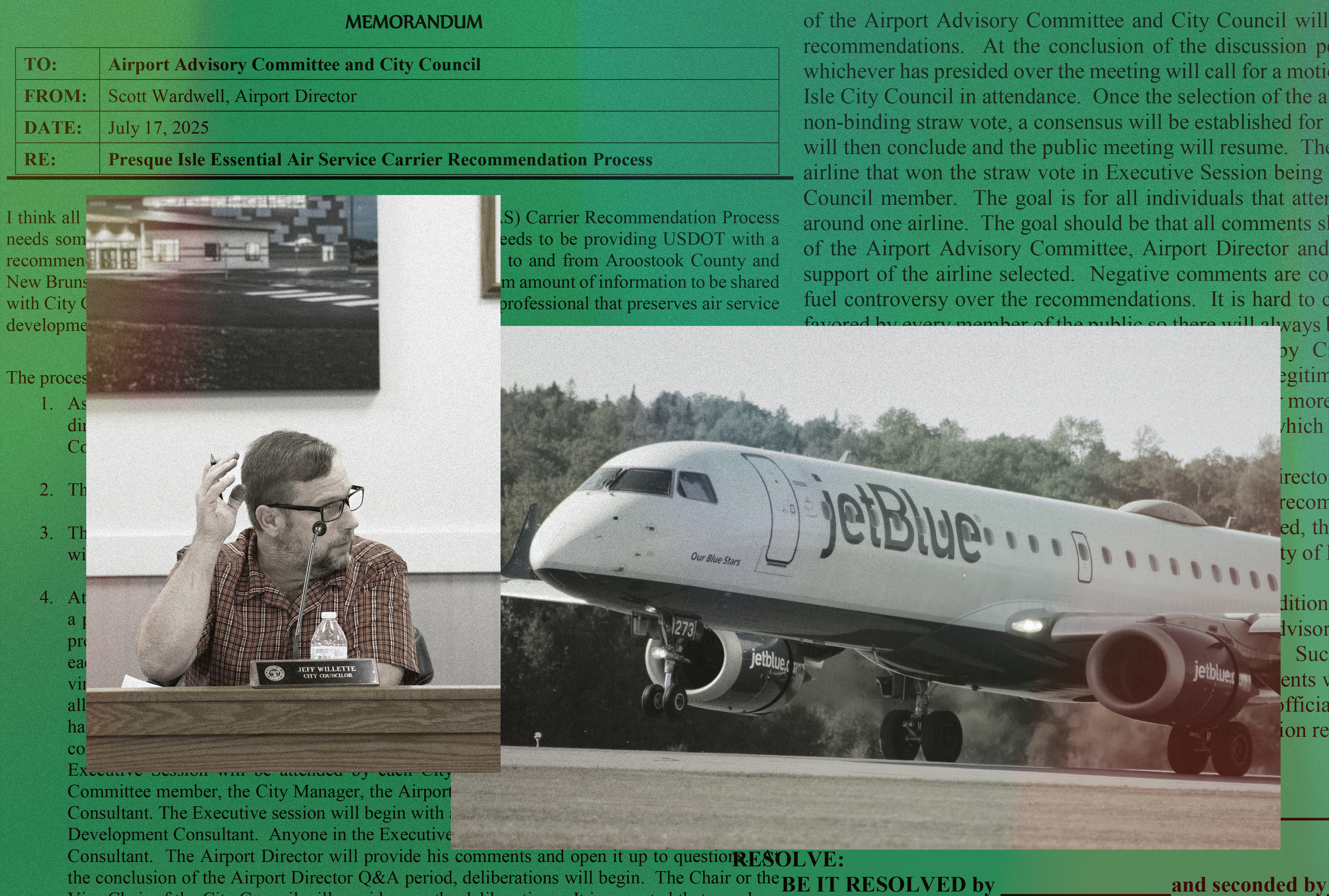
Presque Isle city councilors approved a new policy earlier this month for recommending airlines for the city’s airport that experts say violates both the word and spirit of Maine’s open meeting law.
Now, after the Bangor Daily News began asking questions about the legality of the policy last week, the council has signaled that it may reverse the decision.
Instead of deliberating local air service bids for the Presque Isle International Airport in an open meeting — as the council has done previously — the new policy approved on Aug. 6 requires the council go into a closed-door executive session to reach a “non-binding” consensus before publicly voting on the recommendation to the U.S. Department of Transportation.
The purpose, according to officials, is to avoid heated public debates that could make it harder to attract commercial airlines to the city.
But elected government bodies are more beholden to transparency than corporate boards, and as written, both the stated reason for entering the executive session and the requirement to reach a consensus within it, whether informal or not, appear to violate Maine law, said Portland lawyer Sigmund Schutz, an expert in media and open meeting law.
“I don’t see any basis for holding an executive session to discuss a proposal to provide service to the airport,” said Schutz, who is also the attorney for the Bangor Daily News.
“That whole section that they’re going to be a straw vote and a consensus established is also illegal,” Schutz continued. “They cannot take any votes in executive session on any subject.”
This week, the council added an item to the agenda for an Aug. 20 special meeting to reconsider the policy. That meeting was originally called to fill a missing seat on the council.
Scott Wardwell, the airport’s director, brought the changes before the council to prevent airlines from being “criticized in public,” and to present a unified front with its decision, he said during the Aug. 6 council meeting at which it was approved.
The council’s decision to recommend JetBlue as the airport’s Essential Air Service provider in 2024 faced backlash from the public and United Airlines, the airport’s previous provider.
“It’s not good to basically use a public forum to really criticize a bid or a bidder, because in two more years, they may be your lifeline,” Wardwell told the council. “They may be the only people who bid.”
The legality of executive sessions in public meetings in Maine is regulated by Title 1, Section 405 of the state’s revised statutes. The policy approved last week does not appear to fall under the criteria listed under “Permitted Deliberation” in that section, a list that includes employment discussions, real estate acquisitions and labor contracts, among other accepted uses.
The city’s new policy does not cite the authority by which it is allowed to enter an executive session on the subject. Neither city councilors nor Wardwell were able to point to that authority when asked by the BDN.
The city’s attorney, Richard Currier of Presque Isle, did not respond to a request for comment.
City Councilor Craig Green, who is also president of the Presque Isle Air Museum Committee, said in an email to the BDN on Aug. 7 that “The process of negotiation of contracts is and always will be a legal use of executive sessions.”
But the council’s involvement in the Essential Air Service selection process is to issue a recommendation to the U.S. DOT, which holds ultimate say over which airline bid to accept.
The council approved the new process by a 3-2 vote. Councilors Michael Chasse and Hank King opposed it.
“I think we as adults and representatives of the city and community should be able to choose an airline and disagree without speaking negatively about the other ones,” Chasse said. “I’m not always going to agree with what airline to choose and I think to discuss it in a way that’s not damaging to the people bidding should be OK.”
Chasse explained his position after the vote had already occurred. His statement caused King to change his vote from a “yes” to a “no.” The vote occurred with only five councilors because Councilor Doug Cyr was excused from the meeting early due to a family emergency.
The council is already operating short one member because of the resignation of council member Meg Hegemann last month for family reasons.
No councilor asked Wardwell questions about the proposal. The councilors did not deliberate among themselves before voting.
Essential Air Service is a program under the U.S. DOT designed to connect smaller communities to domestic and international air travel. Essential Air Service contracts can be lucrative to airlines because they are awarded per passenger subsidies by the DOT.

Presque Isle is one of 110 eligible Essential Air Service communities, along with Bar Harbor, Rockland and Augusta/Waterville.
The DOT has final authority over what airline bid to accept for a community, but municipal recommendations can significantly influence the decision-making process.
In 2024, the council’s recommendation of JetBlue’s bid for once-daily round trip service to Boston was echoed in the final DOT ruling — which included a waiver approved by the DOT to allow the number of flights to fall below the minimum requirements for basic essential air service, which mandate two round trip flights, six days a week.
Members of the public and United Airlines pushed back against the recommendation. Legal counsel for United — which had operated as Presque Isle International Airport’s passenger air carrier for the previous six years — called the waiver “unreasonable.”
The proposal approved last week seeks to quell similar controversy in 2026, when JetBlue’s two-year contract expires.
“It’s really counterproductive to all the money that we spend on marketing at the airport to whoever gets eventually chosen to really kind of in public point out maybe the weak points in that decision,” Wardwell told the council before the vote.
It’s a process Wardwell said he modeled after Plattsburgh International Airport in Plattsburgh, New York, another Essential Air Service community. The airport, like Presque Isle’s, used to be a U.S. Air Force base. It serves a city of just under 20,000 and surrounding communities with daily flights to Washington, D.C., and two airports in Florida.
Wardwell compared the process to that of a private corporation, likening the council to a board of directors presenting a unified opinion to better represent a company.
“This selection and the running of the airport, it’s more like a private business than it is like a fire department or a park and rec department,” Wardwell said. “And usually private businesses, the board of directors try to show a certain unity about whatever decision they make.”
But that perspective is not reflective of how the law views it, Schutz said.
“There may be competing policy reasons why someone might argue, ‘Gee, we ought to be able to discuss this, that or the other thing, without the public present,’” Schutz said. “But what the Maine law is saying is that the public’s right to know is paramount and the public’s right to understand what public officials are doing, why they’re making decisions, and to have the accountability and transparency that comes with that outweighs whatever the competing considerations are.”
The policy also appears to mandate that councilors must publicly vote unanimously for the airline that was the consensus choice within the executive session, even if their opinion conflicts with the majority. It states, “The formal vote will be taken with the airline that won the straw vote in Executive Session being unanimously selected by each City Council member.”
Asked about this section of the policy on Aug. 8, Wardwell said the intention was to encourage councilors to vote together, not to mandate it.
“Obviously we can’t mandate anybody to vote a certain way,” Wardwell said.
But that wording is not clear, a fact that troubled Justin Silverman, a Massachusetts-based attorney and executive director of the New England First Amendment Coalition.
“It seems to be forcing individuals to profess an opinion or vote that perhaps they don’t agree with,” Silverman said. “As a matter of the speech rights of those individuals, the members of this body, I have some concern there.”
Wardwell said he was concerned by how split the City Council was on his proposal, and as a result, it will be reviewed by the airport’s legal counsel for changes. He made that comment before the council announced that it would reconsider its decision on Aug. 20.
“We’re going to tighten it up and kind of rework things and get it to a place that, certainly, I want more of the council [to be] comfortable with,” he said.
But for now, as it stands, the policy clashes with Maine law in multiple ways. It also, experts said, runs opposite to the nature of public transparency local governments are intended to operate with.
“I think just as a matter of principle, these are important decisions that are being made and they should be made transparently and they’ve been made transparently in the past,” Silverman said. “That practice should continue. But at the very least, the law should be followed.”