


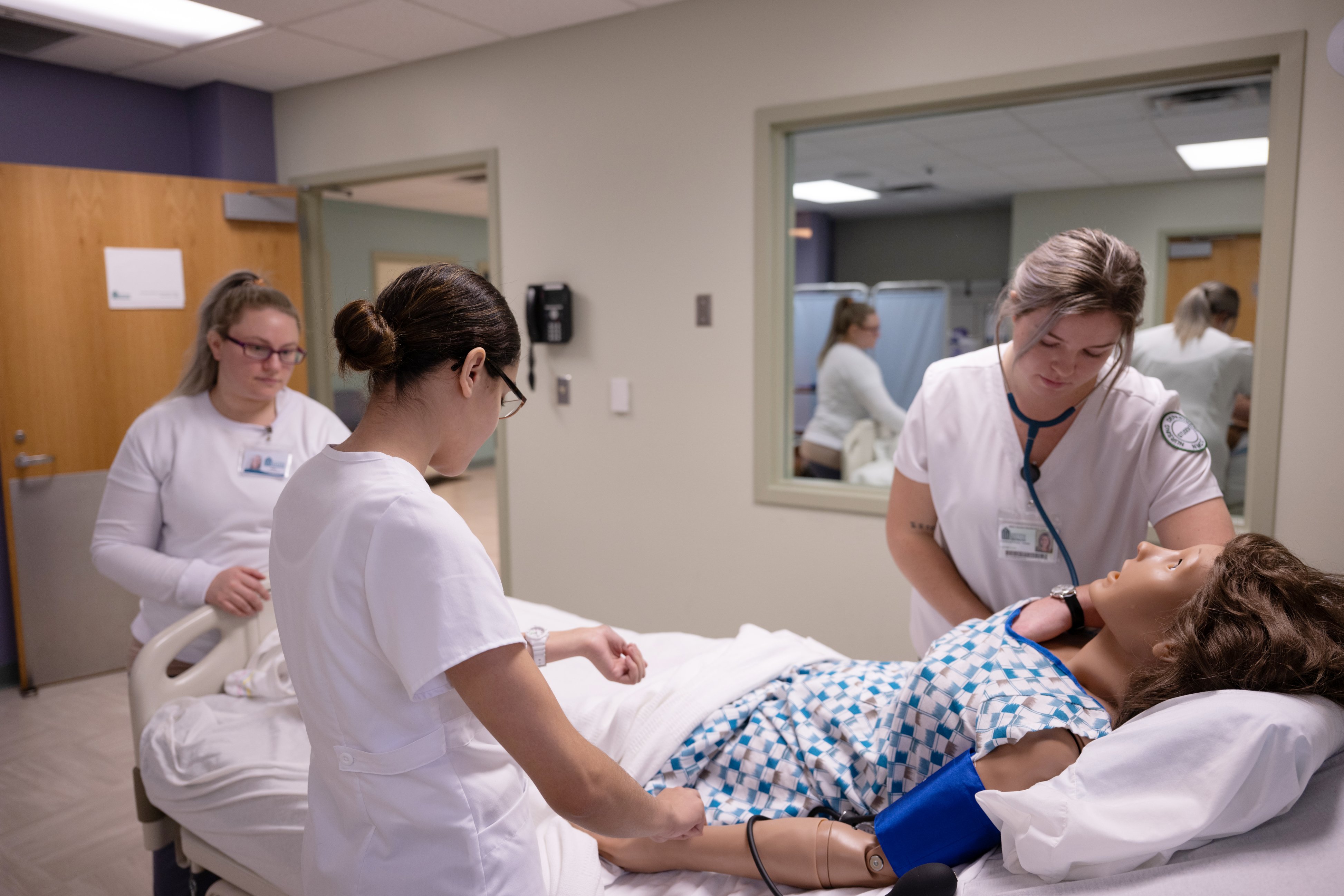
During 2023 and 2024, the nursing program at Northern Maine Community College had no summer break. Instead, it ran a third semester to advance students on an accelerated track toward an associate degree and the exam to license registered nurses.
It’s not a typical offering for the school. But workforce forecasts showed a need for nurses, and the Presque Isle institution responded.
“We just ran straight through so it’s able to graduate more nurses,” NMCC nursing program director Andrew Gagnon said.
The program’s modification speaks to a truth: Aroostook County, like nearly every other part of Maine, is suffering from a significant nursing shortage. But it also hints at a solution.
Data show that The County has more new nurses than any other region in the state, despite being one of the older counties. Programs like the accelerated cohorts at NMCC are part of the reason why.
More than 27 percent of The County’s registered nurses have been licensed in the last five years, the Cypress Research Group found based on registration data collected between Sept. 1, 2022 and Aug. 31, 2024. Of the state’s other six regions — each made up of clusters of counties — the next highest were Piscataquis and Penobscot counties with a combined 25.1 percent.
The combined midcoast region of Sagadahoc, Lincoln, Knox and Waldo counties ranks the lowest, with just 17.3 percent of its nurses considered new.
Aroostook County has approximately 857 registered nurses, a decrease of more than 100 from the period between Jan. 1, 2020 and Dec. 31, 2021, according to the report. It’s a trend mirrored across most of the state, where every region except for York and Cumberland counties — which together employ more than 38 percent of the state’s RNs — saw a drop in nurses compared to 2020-21.
The reason behind this is simple: Maine has the oldest population in the U.S. In 2022, nearly 22 percent of its population was 65 or older. By 2030, the research group estimates that figure could rise to around 30 percent. Its nurses are not immune to that.
“As the report shows us, the overall population in Maine is growing,” said Erin Soucy, dean of nursing, allied health and behavioral science at the University of Maine at Fork Kent. “But we also know from the demographics that the older adult population in Maine is the fastest growing segment of that population. This means that our most experienced nurses are aging also.”
In data collected from 2015 to 2017, there were nearly 5,800 RNs in the state aged 55 to 64, but as more of that group retired from the workforce, the number fell to 4,100 by last year.
The aging out of older nurses also overlaps with a growing need for medical services in Maine, creating a “cliff,” as Gagnon referred to it. That’s the fundamental reason why the state has an estimated shortage of more than 2,100 nurses — which could approach 2,800 by 2030.
Hospital systems and other groups around Maine have worked to tackle the shortage in a number of ways, from on-the-job training partnerships to heightened recruitment efforts. But no region has recently welcomed a higher percentage of new nurses than Aroostook County.
That doesn’t mean nurses in The County are getting younger. The profession’s average age in the region has hovered around 45 for the last decade. But programs that prioritize outreach, attract nontraditional students and work to meet their needs have acted as a stopgap for rural medical facilities. Not only has it helped fill their ranks, but it has reduced their dependence on more expensive short-term nursing contractors, for which hospitals have been forced to spend millions in recent years.
Jennifer Albert did not initially aspire to go into nursing. She moved away from the St. John Valley to pursue a degree in biology on a pre-med track. But when Albert returned to complete her degree close to home, she found that she could graduate with both a bachelor’s in biology and nursing with just 13 months of additional schooling at UMFK through an accelerated program.
Thirteen years later, she’s the chief nursing officer at Northern Maine Medical Center in Fort Kent.
“They really care about job placement and they want students to succeed,” Albert said. “It is their goal for students to pass the NCLEXs on their first try of sitting for their boards, but it’s also their goal to get people where they should be in nursing. They are very astute to people’s interest areas and then also individual strengths.”
UMFK’s undergraduate nursing program can “easily accommodate” between 60 and 70 students annually, Soucy said, which is around how many students have been enrolled in recent years. The school also has a partnership to offer the program at the University of Maine at Presque Isle, which can attract students in central Aroostook who can’t easily commute to Fort Kent.
Both UMFK’s program and the nursing program at NMCC have about an “equal mix” of younger and non-traditional students — the latter a crucial demographic in growing the population of nurses.
“This is a great way to get back into the health care workforce or to get back into the workforce in general if you’re looking for gainful employment and you’re looking for a career and really want to make a difference,” Gagnon said.
In addition to its associate degree RN nursing program, which enrolls around 32 to 40 students per year, NMCC is also one of only three schools in the state to offer a practical nursing certificate program. Licensed practical nurses, or LPNs, work under the supervision of an RN, and are utilized the most in nursing homes and assisted living facilities, an area of health care hit particularly hard by staffing shortages.
Unlike Maine’s population of licensed RNs, which increased from 2020-21 to 2022-24, the state lost nearly 200 LPNs in that period. But in Aroostook County, 8 percent of employed nurses are working as LPNs, the highest percentage in the state, equal with the region made up of Oxford, Franklin and Androscoggin counties.
“We were actually approached by representatives of the long-term care facility, asking if this was something that we could do to help meet that workforce shortage,” Gagnon said. “We stood up to help with that need and the need has persisted … so we’ve continued to run the LPN program.”
These efforts to bring in new nurses will not end the shortage. “There isn’t an easy or quick solution,” Soucy said. And once nurses have joined the workforce, facilities must also work hard to retain them.
But Aroostook County’s nursing programs have evolved to meet the need, a truth reflected in the data, and they may offer a piece of the solution.