

HODGDON, Maine — A Columbine shooting survivor shared with Aroostook County students earlier this month how he hid in heart-pounding silence as the bullets sprayed the school library where he was hiding.
Craig Scott, a sophomore at the time, watched as two friends on either side of him were killed in the notorious April 20,1999, Columbine school shooting that killed 13, including his sister Rachel.
“My story starts with one of the most painful things that I went through in my life and that has led to the most purpose in my life: the day the shooting happened at my high school, Columbine in Littleton, Colorado,” Scott said.
On that April morning, Columbine High School students Eric Harris and Dylan Klebold armed themselves with guns, bombs and ammunition, headed to their school to kill their classmates and opened fire. As they walked the halls toward the library, where Scott was hiding with about 50 other students, the pop, pop, pop of gunfire and pipe bomb explosions grew louder, Scott said.
Although school shootings have been recorded since the 1800s, Columbine was the first fatal high school shooting of such magnitude that rocked the nation, giving rise to calls for gun control legislation, mass shooter training and tighter school security. Despite the increased attention to guns in schools after Columbine, the numbers have only escalated. There have been more than 390 school shootings, killing at least 203 and injuring 441 students, educators, and other individuals on K-12 campuses, according to Brady, a Washington, D.C.- based gun violence prevention organization.
Afterward, Scott was so angry and he held onto that anger by disconnecting with other people, he said. He began to blame the world for how he felt, not realizing that his emotions and feelings were coming from the way he was thinking.
“It’s your thoughts that create your emotions and feelings,” he said. “We end up taking out our anger on people that are close to us, and when you act out in anger you often do a lot of things you regret. I did a lot of things for the next couple years that I regret. I was hard to be around.”
A mission trip to South Africa right before his senior year changed him, he said. Each day they would go into refugee camps where entire families would live in tents or shacks and have to share one meal a day and walk miles for water. And yet the people were filled with peace and joy.
“What I saw there had such an impact on me,” he said. “And even though they had next to nothing, I still saw family and friendship.”
And one night an African man encountered Scott outside late when he couldn’t sleep and was having violent nightmares.
“He could tell I was upset. He said, ‘Tell me your story,’” Scott told the students. “I told him about losing my friends and my sister and he listened and told me his story. One day he came home on his bicycle during apartheid and his entire village had been brutally killed with machetes, as was his entire family.”
Scott said he wondered how this man could sing and be joyful after losing everyone he loved.
“He said, ‘Forgiveness is like setting a prisoner free and then finding out that prisoner is you,’” Scott said.

That’s when he decided to forgive the two shooters and use his painful experience to help others in a positive way through the power of storytelling. So, for 25 years, he has traveled the world sharing the story of the massacre and his sister Rachel’s message of kindness and resilience.
“My sister made it her mission to make an impact, especially for people caught on the outside that no one else seemed to care about. She didn’t care about popularity, she cared about real friendships,” Scott said.
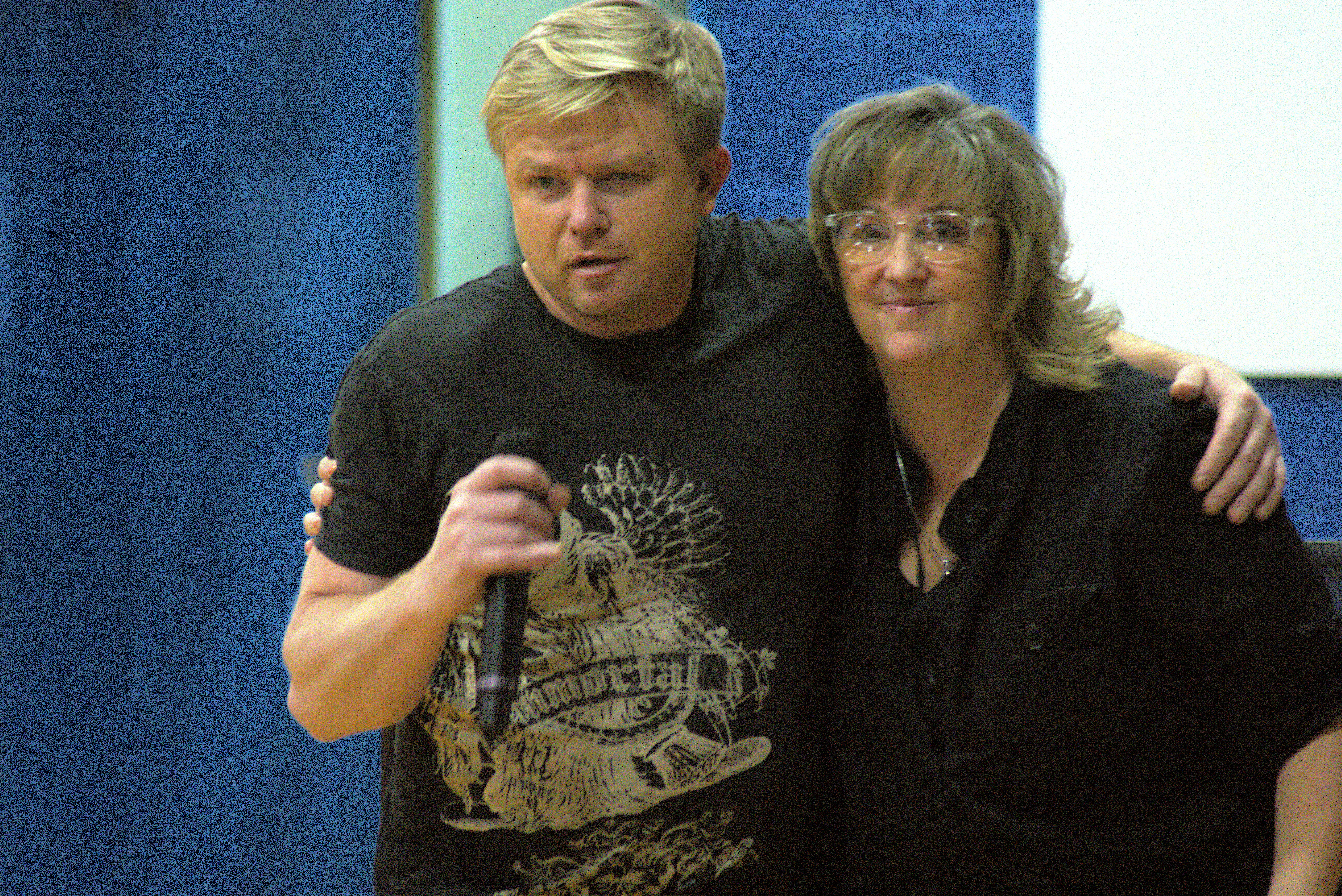
To honor his sister’s philosophy of loving others, Scott’s programs are all about reaching out to each other and honoring self and others. And many of the schools along the way take on Rachel’s Challenge, a proactive way to address the root causes of school violence, bullying, prejudice, and self-harm.
It’s all about improving school culture. And the first thing he does when the workshop begins is have everyone give five people hugs and high fives, followed by a game of Simon says.
“Boom, Boom,” he said, with each high five he gave.
Mill Pond Elementary School Counselor Leslee Mahon secured a U.S. Department of Education Stronger Connections Grant based on Rachel Scott’s life theme of Starting a Chain Reaction of Kindness. As part of the grant, she was able to bring Scott to the district, where he worked with students in four workshops, two at the elementary school and two at the high school.
“The Stronger Connections Grant has allowed us to weave a theme of positive leadership throughout the school and community,” said Mahon. “We have had Rachel’s Challenge for two years and we still wear chain reaction T-shirts every Friday to symbolize how one act of kindness can start a chain reaction of compassion.”