

Editor’s note: Aroostook County Soil and Water Conservation Districts and the National Resources Conservation Service are highlighting Aroostook’s female farmers as part of the United Nations declaration of 2026 as the International Year of the Woman Farmer. Maine is participating in various ways to showcase the essential roles that women play within all aspects of agriculture.
Erica Fitzpatrick Peabody
Fitzpatrick & Peabody Farms, Houlton
If you grew up in Aroostook County and are of a certain age, you know firsthand just how integral agriculture was within the fabric of communities.
Family farms were common and everyone pitched in at some point as needed. Whether it was with cooking or child care, cutting potato seed, planting crops or rock picking, many helped in some aspect. And of course, during the fabled potato harvest, kids were released from school for three weeks to work on farms to help harvest the potatoes.
That was the kind of agricultural family and life that Erica Fitzpatrick Peabody was born into and raised, and it is one she now works to emulate as she and her husband navigate their own family farm and raise their three children within those farming traditions.
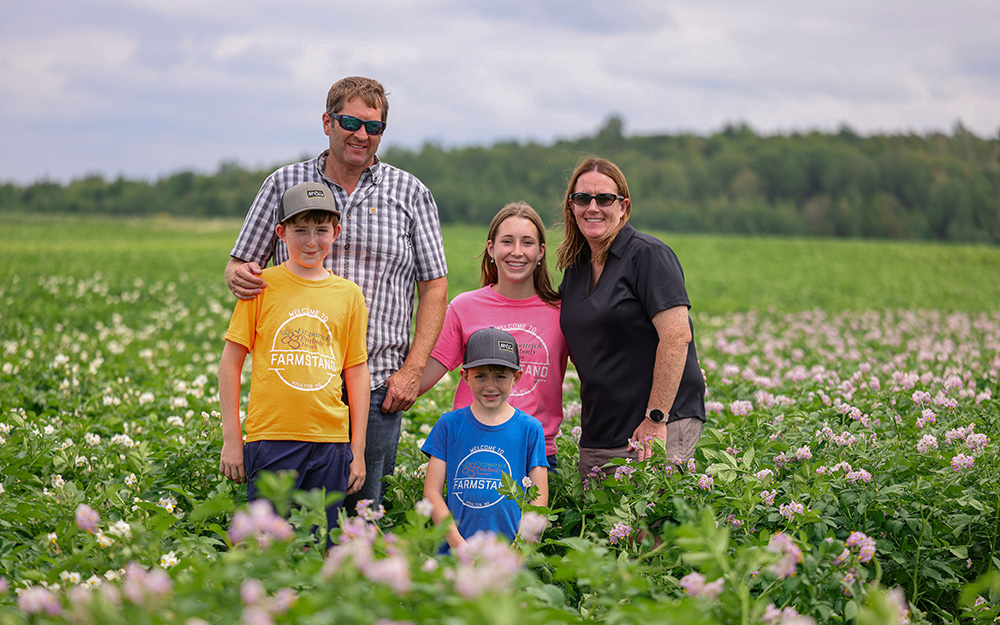
Erica’s path to successionally leading her family’s generational potato farm has always involved agriculture on some level. From starting her first garden at age 9 and working on a harvester beginning at age 11, she developed an interest in learning more about the science behind agriculture, eventually receiving her master’s degree in agronomy from the University of Maine.
Her degree led her further along the path as a corporate agronomist for McCain Foods.
She got married, began having a family, and eventually came to realize that while she still loved the science of agriculture, her heart was really in farming. In 2017, she decided to farm full-time, taking advantage of getting to work with her dad, Albert, on a daily basis to glean the necessary and valuable bits of farming knowledge and experience from him.
As Erica noted, farmers work in acres, not hours, and while farming is not for the faint of heart, she hasn’t looked back.
Since farming requires more hours than traditional professions, raising a family takes a village — and Erica knows how lucky she is to have help with an extended family that regularly steps in as needed.
Being part of a generational family farm also enables her to benefit from the work of the previous generation, a legacy she keenly values. It’s something she does not take for granted and uses it as a teaching moment with her own children as they become interested in the different aspects of farm-related work.
For example, when it comes time to dig the small section of field for new potatoes for their family farmstand, it’s that generational equity the kids rely on when they use their grandfather’s pull-behind two-row digger to dig the few feet needed to fill the potato bags to sell.
Since farming has become so mechanized, exposing their kids to farming at this market-garden scale is important to Erica and her husband, Barrett. Their kids help build a budget for the two acres they grow, which is at a scale they can understand. Their involvement with growing crops for the farmstand also exposes them to changes in plant growth, seasonality, weather impacts, and even provides them an experience with customer service.
As for the daily work involved, the weekend lake time they prioritize as a family motivates everyone to get the work done so they are able to make that happen.
That generational equity may have allowed Erica to move into farming, but her knowledge as an agronomist has moved the farm to new levels with extensive field management plans based on grid-patterned soil sampling.
She likes to say that she mainly works behind the scenes. She jokes that if someone sees her driving a farm truck, they’ll know things have really fallen apart, because everyone else is a better operator. Her agronomy knowledge brings her out in the fields and storages regularly to scout for pest pressure and potential disease issues, and assess the overall health and vigor of the crop.
Being involved within the community is something else Erica cares about and uses action to teach her children the value of community involvement. She serves as the executive director for the Agricultural Bargaining Council, working in tandem with other processing-contract farmers in Aroostook on complex potato contracts. Being a part of the ABC allows farmers to work with one another for the benefit of all.
She also volunteers her time within her local community, serving in civic positions and providing agricultural education when she can.
Ultimately, she feels extremely lucky to be farming and able to raise her kids within a family farm framework. She loves the changing cycle of agriculture and the diversity of work that is required. As long as she is able, she’ll continue to keep agriculture a part of the fabric of this community and its rural heritage.
Angela Wotton works as the district manager for the Southern Aroostook Soil and Water Conservation District, assisting landowners with stewardship of soil and water resources.