


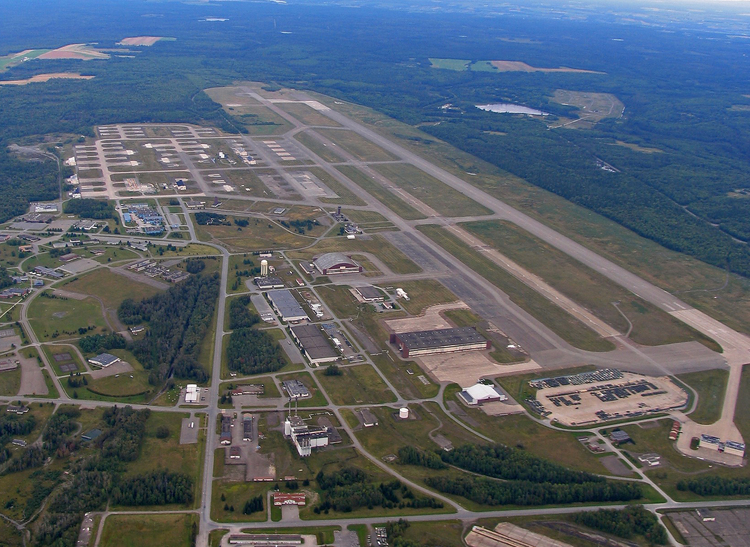
Maine’s first artificial intelligence data center, which will be housed in a warehouse at the former Loring Air Force Base in Limestone, will be powered by “revolutionary” cooling technology, an executive at the company behind the project told the Bangor Daily News on Wednesday.
LiquidCool Solutions, which will power the Loring LiquidCool Data Center, will use its “immersion cooling” technology in the facility, which it says will “eliminate” water consumption in the cooling process.
The technology offers a solution to a problem that has plagued communities surrounding large data centers as the global race for AI innovation speeds up.
“With AI, the chips are too hot,” LiquidCool Solutions vice chair Herb Zien said. “Air can’t do it anymore.”
High-processing servers needed to train and run AI services efficiently produce immense amounts of heat, which would degrade equipment without cooling systems. But many data centers use evaporative air cooling systems that can require millions of gallons of water annually to run, taking away supply from nearby areas.
Electronics in the LiquidCool Solutions servers are immersed in a dielectric liquid — which has high electrical resistance — that acts as a coolant, dissipating much of the heat that a server gives off.
“For decades, air cooling was what was used to cool data centers, and it was always a bad idea,” Zien said. “Air’s a ridiculous medium to cool anything. It’s an insulator. We became involved with getting rid of the fans.”
The data center, which was announced Tuesday, is located within the 450-acre parcel of the former base owned by clean energy and development firm Green 4 Maine, a company attempting to revitalize the area through new business.
Scott Hinkel, co-founder of Green 4 Maine, said that he envisions a “campus” of data centers within an area his company calls the “innovation hub,” and that they are already in talks with other companies.
Loring LiquidCool Data Center leased a 115,000-square-foot warehouse on the eastern portion of the former base and expects to become operational in around six months, Zien said.
The data center will begin with five to six megawatts, but could reach up to 50 at full capacity. That would mean around 20,000 operational servers and potentially a dozen employees.
Loring is a prime location for such facilities because of several factors. The 1,100-mile upgrade to the state’s fiber optic network, called the “Three-Ring Binder,” which was completed in 2012, ran optical fiber cables through the former base and directly connected it to the Metropolitan Area Exchange-East internet exchange point.
The area also has access to ample electricity from hydropower generation in New Brunswick, and several existing buildings fit the needs of data centers without the need for new construction.
“It’s almost move-in ready,” Zien said of the warehouse the data center leased. “Data centers today, because there’s an explosion of construction, sometimes they’re four or five years away before somebody could actually walk in the door.”
The facility will likely operate as a colocation data center, where companies can rent out server space. It is in talks with some initial tenants, but welcomes the prospect of bringing in Maine-based companies.
“We’d like this to be Maine focused, frankly, if there’s a way to do that,” Zien said. “I think it’ll be an example that’ll get a lot of publicity in and outside of the United States because it’s gonna be revolutionary.”
Zien described the cooling technology industry as “at an inflection point,” where companies and data centers are realizing air cooling is no longer a viable solution to effectively meet the demand of AI.
“In 13 years, everything changed,” he said. “[Air cooling] was a bad idea to begin with, but people were living with it. It wasn’t the right answer for this next generation … It’s energy inefficient and using it requires a lot of water. It’s noisy. Now liquid cooling is coming in.”
In addition to eliminating water consumption, LiquidCool Solutions says its technology reduces energy consumption by up to 40% and data center space by up to 70%. So at full capacity, the Loring LiquidCool Data Center would only use about half of the space it has leased, Zien said.
And 90% of the waste energy the servers produce is recaptured through hot water heaters connected to servers, the company says. It hopes to use the remainder of its warehouse to bring in another business that could use that water.
“Our thought was we could use the waste heat for some agricultural activities in the other half of the building, for example, dehydrating crops,” Zien said.