


The Presque Isle City Council advanced progress Wednesday on its aerospace research park, approving more than $600,000 in bids for several different projects.
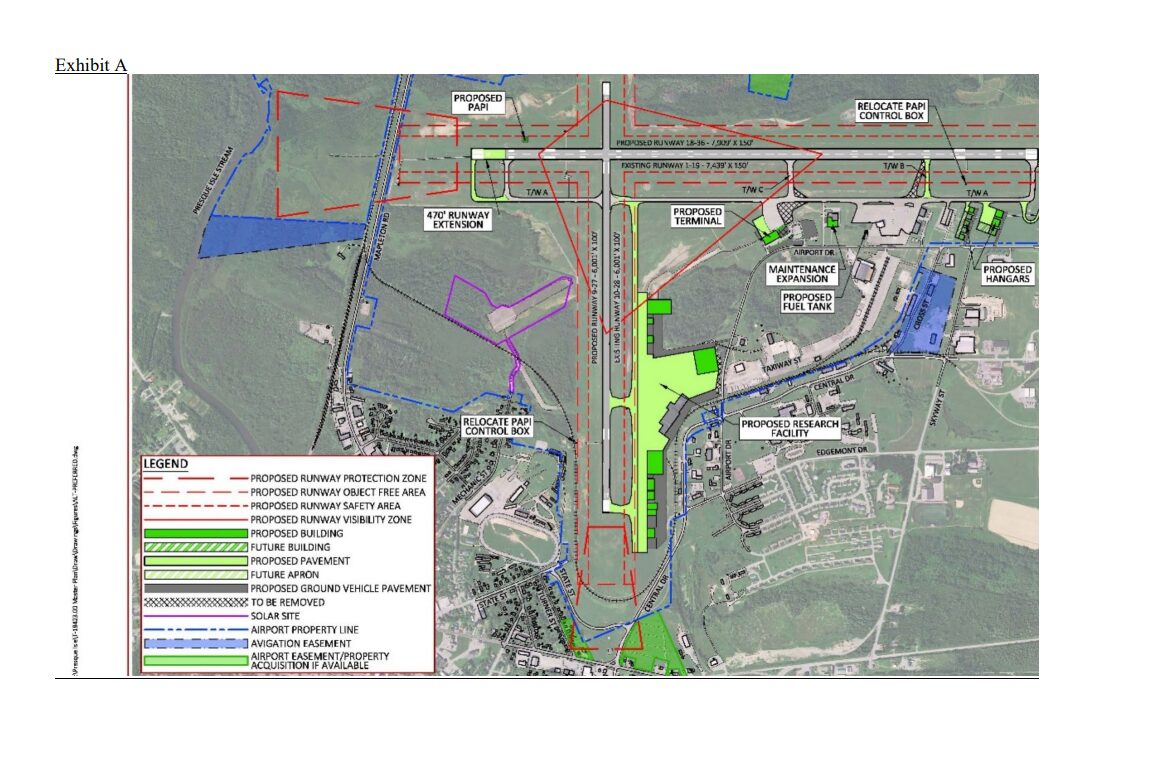
The city broke ground in August on the John F. Kennedy Aerospace Research Park, a 72-acre area within the campus of the Presque Isle International Airport.
The park is intended to house 11 buildings with more than 420,000 square feet of hangar space and employ more than 400 engineers and scientists, Airport Director Scott Wardwell said. The goal is to help grow Maine’s space economy and provide local science-based jobs.
“This is where we really start to take this park from kind of a conceptual thing to actually putting some meat on the bones,” Wardwell said.
The council accepted four separate bids for development at the airport during its regular meeting Wednesday. Three are directly tied to the research park, totaling $609,000. Most of the cost of the projects will be covered by federal grants and Federal Aviation Administration COVID relief funds.
The estimated price tag for the entire park is $6 million.
Its first tenant, VALT Enterprizes, a company that develops hypersonic delivery systems, has operated out of the airport’s general aviation area since 2021. Company President Karl Hoose told councilors Wednesday that VALT currently employs 30 people, but anticipates that growing to more than 90 in the next year.
The company regularly contracts with the U.S. Department of Defense and pays an average salary over $100,000, Hoose said.
Around 90,000 square feet of the park’s space could come from the former International Paper Company building at 310 Airport Drive that currently is used for cold storage. The council authorized spending Wednesday up to $250,000 to cover an evaluation of possible reuse of the building for the research park. Potential uses outlined in a memo include aircraft hangar storage, a high-speed blowdown wind tunnel, a machine shop and a metallurgical lab.
The evaluation will be conducted by C&S Companies, an engineering consulting firm based in New York. The cost of the project will be 95% covered by a grant from the FAA Airport Improvement Program and the remaining 5% is set to come from the airport’s passenger facility charge reserve account.
Large additions to the building added by the International Paper Company may have to be removed, the memo and other officials acknowledged.

“We have an old master plan from 1968, and it even says in that old master plan [that] this building is not at its best and highest use,” Presque Isle Industrial Council Executive Director Tom Powers said. “I think that’s a very fair statement to put out there right now.”
The council next approved $200,000, funded identically to the previous project, for the creation of a master plan for the research park, conducted by construction and project management firm MCFA and architecture firm Harriman, which is based in Lewiston.
The council awarded another bid to Harriman for the schematic design of a 50,000-square-foot facility within the park intended to be used as an Aerospace Development Center.
The $159,000 price tag for the design will be covered by Federal Aviation Administration Covid Relief funding.
The total cost of the research park is estimated to be $6 million, $4.5 million of which will be covered by a 2022 grant awarded by the U.S. Economic Development Administration.
A fourth project approved Wednesday authorized $6,960 for a cost estimate of an additional five-unit T-hangar north of the airport’s general aviation terminal to the Portland-based PCM company.
The airport first added a five-unit hangar in 2020. That space, which is leased to the owners of small private planes, is at 100% occupancy and there is a waiting list of five people interested in a hangar space, Wardwell said.
“The development of new hangars can be a fast track to accelerating airport revenue,” said Sean Collins, the eastern regional manager of the Airport Owners and Pilots Association.
“On average, 40% of airport revenue is derived from aircraft hangars, either through direct revenue or ground leases through private hangars,” Collins said, citing a survey conducted by the AOPA that found there is rampant demand nationally for new hangar development.