



Some ice fishermen walk into a bait shop, plunk down their bucket and their money and then happily head for the lake with whatever size, shape and species of bait fish the owner has dipped out. Other winter anglers stand over the bait dealer’s shoulder pointing out the exact minnows they want, or in many cases they actually select and net their own bait.
Experienced ice drillers know that certain lakes and varied species of game fish require particular live bait to produce consistent action. No matter where, when or for what quarry you’re ice fishing, the species, size, condition and method of hook-up of each live bait is crucial to success.

(Courtesy of Bill Graves)
As a general rule, for bragging-size trout, salmon and togue, smelt are the most dependable live bait. For most outings, 5- to 7-inch smelt are the prime size. Pin smelt tend to average 4 to 6 inches while Jack smelt run 7 to 10 inches and many anglers have a definite preference when both are available. Despite their effectiveness in attracting game fish, these shiny silver daters have several shortcomings.
First off, they’re noticeably expensive at $18 to $20 a dozen. Furthermore, they are often scarce, since bait dealers keep far fewer smelt on hand than other species of bait fish. Smelt also tend to be fairly fragile compared to minnows. They don’t travel well in bait buckets, they are susceptible to severe water temperature changes, and if grabbed and released by a game fish, smelt often won’t survive when other bait fish might.

(Courtesy of Bill Graves)
It’s not unusual to use up twice as many smelt during an outing as you would minnows, but for many anglers that’s acceptable. Despite being a bit frail and fairly expensive, smelt are just more dependable when seeking big fish. Check smelt baits often, at least every 30 minutes, and at any decline in activity level, hook on a fresh smelt.
When it comes to selecting minnow species for ice fishing, the variety is wide and choice is mostly dictated by personal preference. Black nose dace, silver shiners and golden shiners are very popular, and all are very resilient and active once hooked up.
Golden shiners in the 3- to 4-inch range have always been productive on brook trout, brown trout and splake for me. Silver shiners and larger dace seem to produce more salmon. Perch and pickerel tend to be far less picky and gobble up any minnow species.
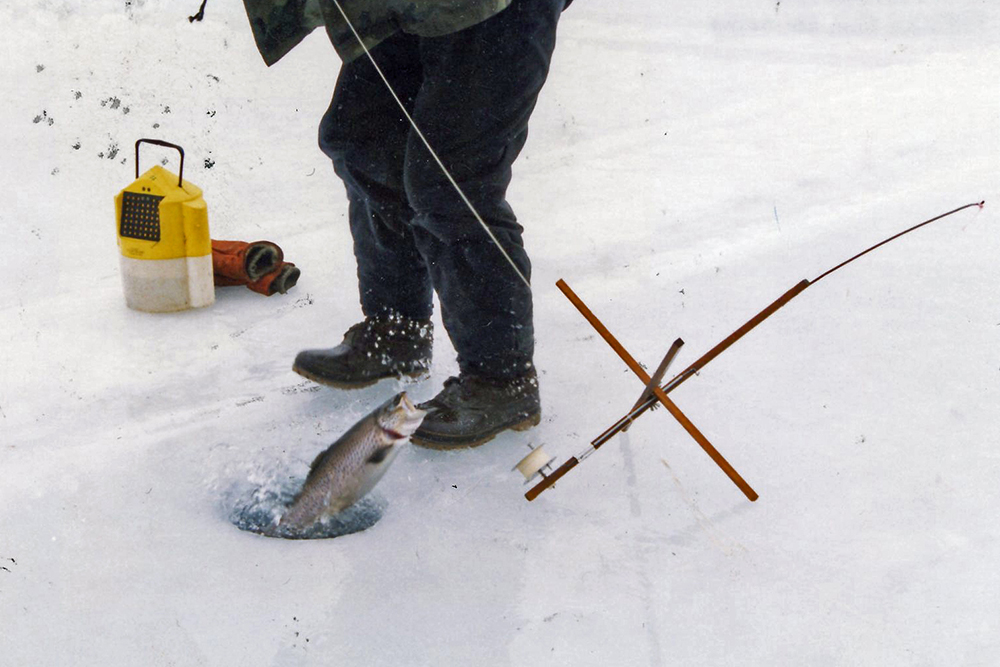
(Courtesy of Bill Graves)
On all-day outings, it’s important to keep bait buckets well aerated to keep bait fish active and healthy. If a small aerator isn’t available, changing about a third to half of the water every four hours will do the trick. If a large number of bait fish is being maintained in one container, say around three to six dozen, proper aeration and water changes every two hours will assure lively bait all day long.
To many winter anglers, how a bait fish is hooked up is as important as its species and size. Some swear a game fish grabs a minnow and turns it to be swallowed head first; therefore, hooking the bait through the lips will assure a better chance to hook up. Hooking bait through the lips also seems to allow very free, natural movement as the minnow swims about.
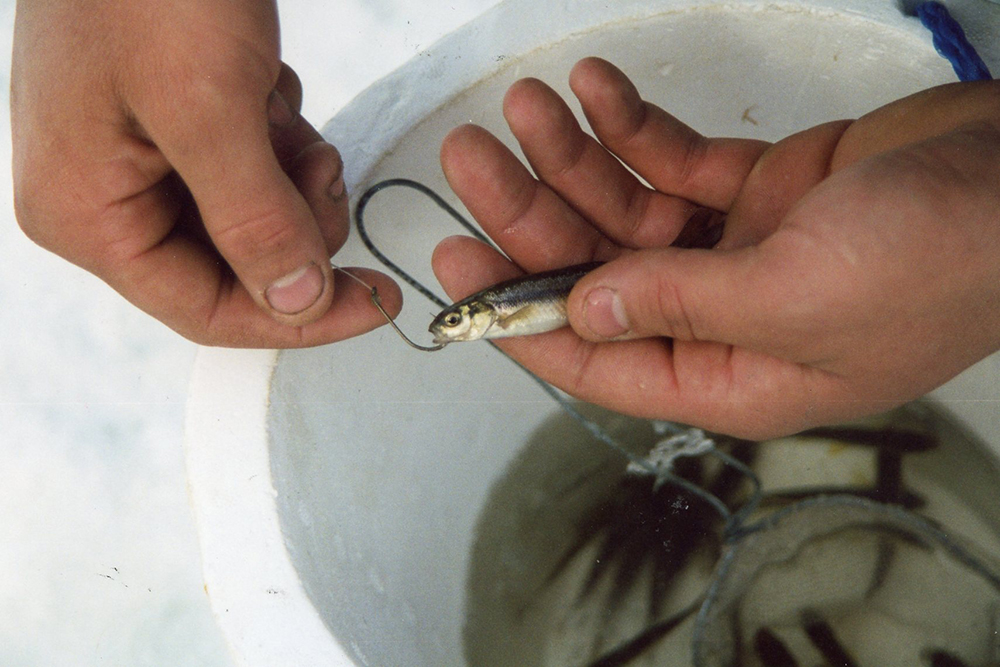
(Courtesy of Bill Graves)
Another popular method of attaching a minnow is through the back muscle just behind the dorsal fin. This is popular for smaller baits, which are often grabbed from the side by a large quarry and swallowed as the fish turns to swim away. I prefer this method and maintain a good hook-up-to-flag ratio. The use of circle hooks can further ensure solidly hooking most game fish taking a bait on a regular hook.
A few anglers hook their shiners near the tail. This of course impedes swimming ability, and gives the look of an injured bait fish, which supposedly further entices a game fish to grab the bait.
No matter how a bait fish is hooked up, I’ve found that not setting the hook until a biting game fish has stopped taking out line works better than during the initial run. Once a run stops and the big fish is swallowing the bait, gently take up slack, visualize the angle of the line and set the hook directly opposite.
Keep a steady pressure during the tug of war with no loose line and your percentage of fish on the ice will increase.