
Over the next few months, Aroostook County Soil and Water Conservation Districts and the National Resources Conservation Service will contribute a regular column in The County, highlighting Aroostook’s female farmers as part of the United Nations declaration of 2026 as the International Year of the Woman Farmer. Maine is participating in various ways to showcase the essential roles that women play within all aspects of agriculture, worldwide and here at home, including food security, nutrition and economic resilience. Our new column will highlight women farmers from southern Aroostook to the St. John Valley. Join us to learn more about the women farmers of Aroostook County as we celebrate their contributions to rural life.
This week, we feature Michele Bye of Bye Brook Farm in Linneus.
At one time, there were more sheep in Maine than people, shepherdess Michele Bye tells me. For communities, that meant experiencing an annual rite of spring: sheep shearing. Shearers would travel a circuit throughout the state, relying on locals to help with the process of moving and handling the sheep, shaking the shorn fleece on skirting tables of slats to pull off the dirty bits, and then gathering it up to be wrapped and labeled with each sheep’s name.
These gatherings were, and continue to be, hard and demanding work, but they were also a time to enjoy a shared meal and community bonding. And for those who helped, the traditional method of payment was choosing their own fleece.
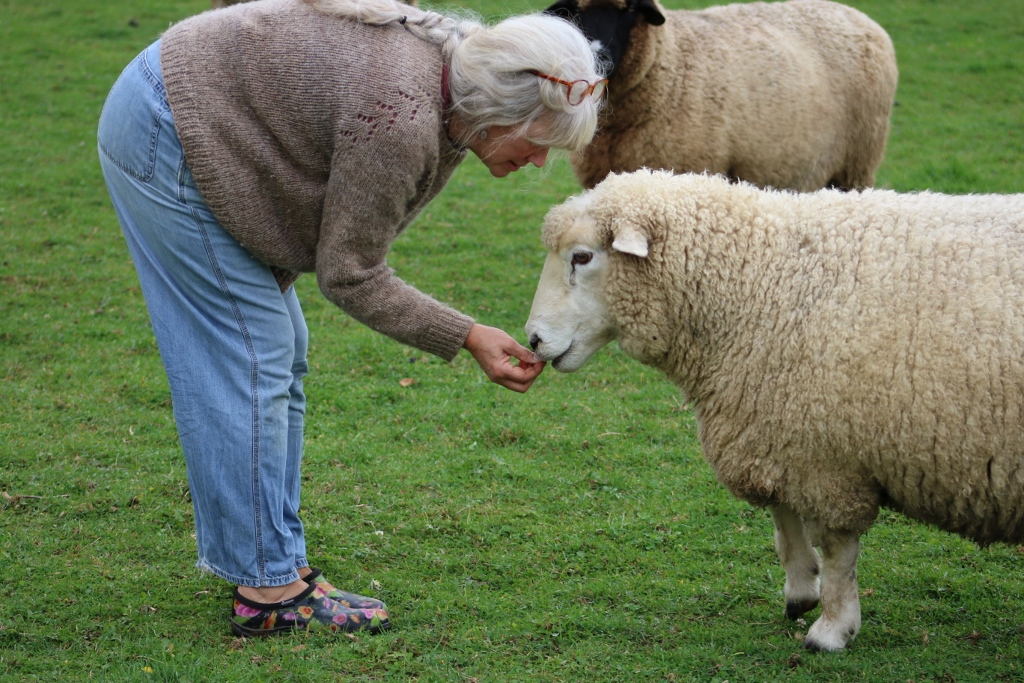
While Bye grew up with a few sheep, it wasn’t until the 1990s that she began her more formal venture as a fourth-generation shepherdess. Her decision was deeply influenced by three different women, all of whom mentored her in traditional sheep farming. Her neighbors, for example, had Suffolk sheep and provided her with practical and old-timey farming advice. Another of her mentors and close friend introduced her to the shearing parties that still existed, carrying on the tradition of the community gathering and the celebration of breaking for a meal of good food after hard work. She also began building relationships with buyers and those within the wool community to sell her wool that she didn’t keep to dye and spin into yarn for herself.
Bye and her family moved to Linneus in 2007 with 12 Romney sheep, eventually growing the flock to 40. During this time, she would leave her own sheep for a couple of weeks each year to help with the long-held tradition of sheep shearing on Nash Island off the coast of Maine. Wild sheep inhabit the island year-round, and the family that oversees the island and care of the sheep include Eleni and Wren, a mother-daughter shearing team that do their own Maine circuit of spring shearing.
Bye and I talked about these traditions and how they have shaped her life. She tells me that it has been the biggest honor of her life to participate in the Nash Island gatherings and develop friendships with those involved.
At this time in her life, she keeps a more manageable herd of 20 sheep, continuing to sell the raw fiber, but her knitting projects have switched to focus more on those for her grandchildren.
When I asked her what she likes about sheep, especially her own, she said that their mere presence grounds her.
“Sometimes, I’ll just lay in the snowbank in winter, listening to the sound of them munching their hay. It’s peaceful,” she said. “I don’t think I could ever not be without sheep.”
Angela Wotton works as the district manager for the Southern Aroostook Soil and Water Conservation District, assisting landowners with stewardship of soil and water resources.