


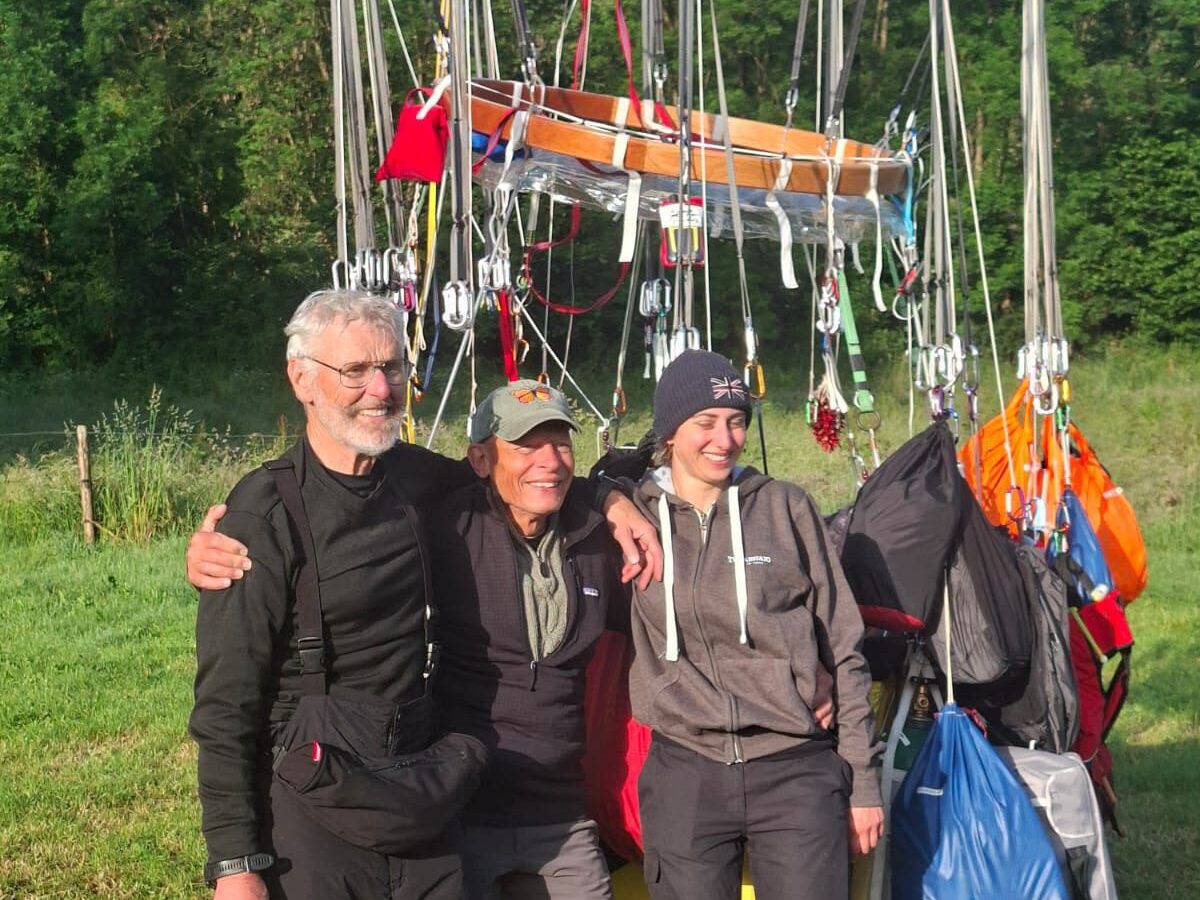
The Atlantic Explorer hydrogen balloon and its three pilots landed safely in Luxembourg Sunday morning, the team’s publicist said.
The pilots, Bert Padelt of Pennsylvania, Alicia Hempleman-Adams of England and Peter Cuneo of New Mexico, lifted off from Presque Isle early Thursday morning, bound for Europe in a bid to fly the first hydrogen balloon across the Atlantic.
Their success means they’ve soared into ballooning history. The three pilots are the first to complete a trans-Atlantic crossing in an open-basket balloon powered by hydrogen. But the flight is historic for Hempleman-Adams as well, who has become the first woman to cross the Atlantic in a gas balloon.
She and her father, balloonist Sir David Hempleman-Adams, are also the only father-daughter team to have each crossed the Atlantic by balloon.
“We are very pleased to report that the Atlantic Explorer hydrogen balloon landed safely on the morning of June 7 near the towns of Diekirch and Bettendorf and the village of Tandel in Luxembourg,” Explorer publicist Kim Vesely said early Sunday. “Their journey… is the first successful crossing of the North Atlantic Ocean in nearly 20 years.”
The pilots are tired but in high spirits, and look forward to showers and “getting some sleep in a real bed,” Vesely said.
The journey started in Presque Isle, where all four attempts to fly the Explorer have taken place. Lead pilot and balloon builder Padelt was enthralled with the Double Eagle II, which also launched from the city in 1978 and became the first balloon to cross the Atlantic. He dreamed for years of making a similar flight, he told the Bangor Daily News in 2023.
That year, the first Atlantic Explorer attempt was grounded due to weather. Poor conditions cut short another try in 2024, and the pilots landed on Prince Edward Island last year because of a suspected gas leak in the balloon.
After lifting off around 2 a.m. on June 4, the balloon traveled over Canada before reaching the open ocean late Thursday night. They traveled at speeds topping 90 miles an hour at times, Vesely said.
They skirted the coast of Normandy, France, on June 6 – the 82nd anniversary of D-day – and brought the balloon down in Luxembourg early Sunday.
Details have not been confirmed, but early estimates are that the team traveled 2,853 miles in 70 hours and 11 minutes, according to Vesely.
“Project leader Bert Padelt extends his thanks to all those who participated in the success of the flight – the people of Presque Isle who hosted the launch (especially landowner Paul Cyr, who extended his hospitality to the team over the four years of the project), the teams who prepared, launched, and are retrieving the balloon, and the core Flight Control team – the air traffic experts, balloonists, meteorologists, and other specialists whose support was crucial to the project’s success,” Vesely said.