
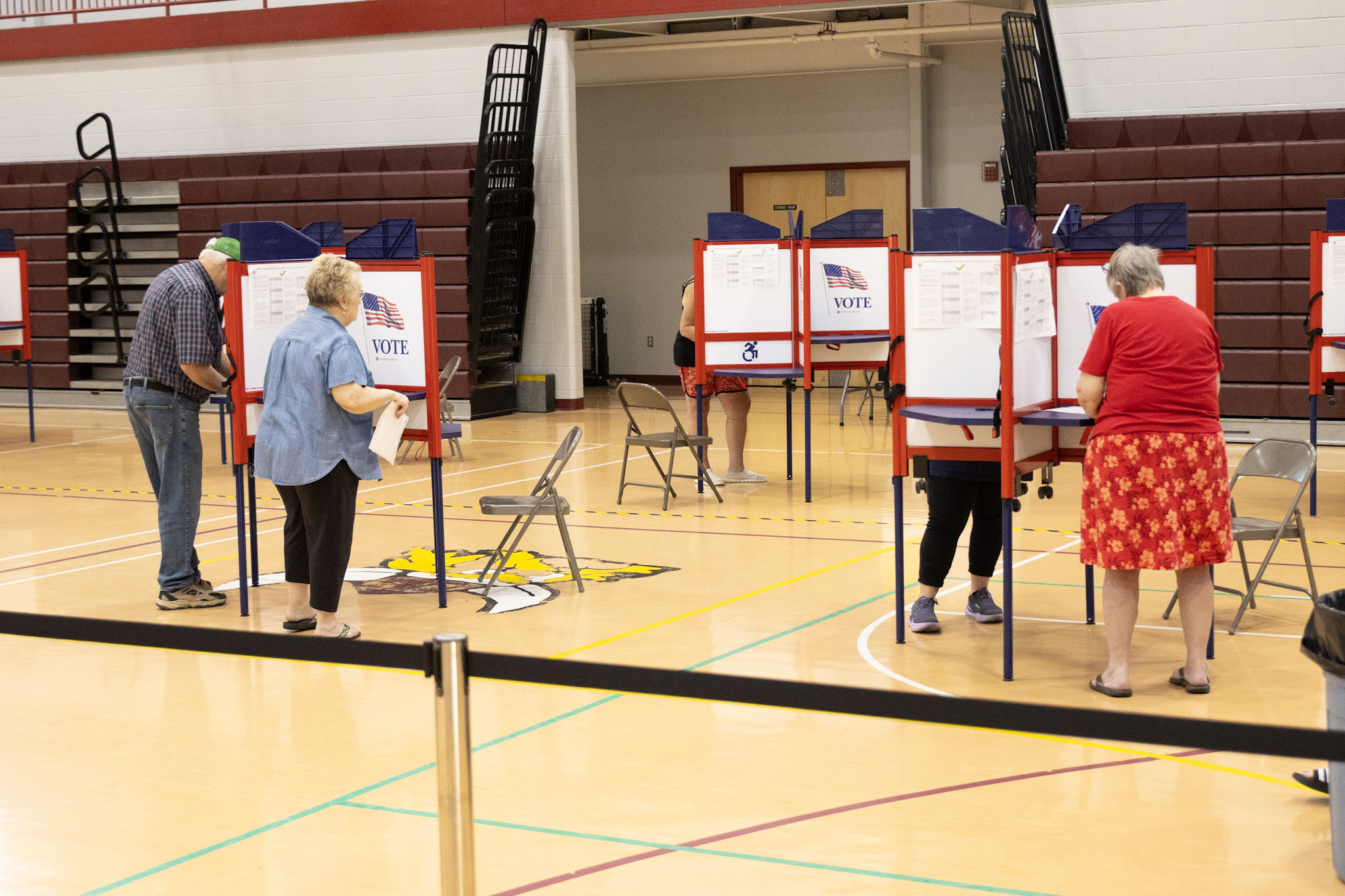
In stark contrast to the spate of school budget rejections around Maine last summer, four Aroostook County districts that faced strong opposition in 2025 roundly passed their budgets at referendum Tuesday, echoing a trend in voting booths across the state.
Voters from districts based in Fort Kent, Madawaska, Caribou and Hodgdon all approved their budgets during Tuesday’s high-profile primary elections. Those districts were among at least 16 where Maine voters rejected proposals last summer, as residents revolted against property tax increases amid the broader affordability crisis gripping Maine.
No budgets decreased versus the previous year. Some, like that of Caribou’s RSU 39, will raise local taxes by more than twice the amount last year’s rejected budget would have. And Mainers are facing even higher costs. So why did voters overwhelmingly approve the school plans on Tuesday?
The answer could lie in the election turnout, said Mark Brewer, chair of the political science department at the University of Maine.
In the sample size of Aroostook districts above, almost twice as many people voted in budget referendums compared to the June 2025 election. Those voters were largely driven by the most prominent races — the Democratic Senate and 2nd Congressional District primaries, and the gubernatorial primaries — and less apt to have a strong opinion on a school budget.
“If people are going to vote solely based on the school budget, they’re generally coming to vote against it,” Brewer said.
“If you’re going to put the school budget out there on its own without anything else in some years, but then in other years it’s going to be accompanied by all of these other things … whether that be primaries or ballot questions … you run the risk of this kind of variance in terms of an electoral environment,” he said.
Voters in Lewiston rejected their school district’s budget in May, but passed a revised version Tuesday with a turnout more than double what it was for the first referendum.
The makeup of the races also skewed Democratic, a demographic that is generally “more likely to approve school budgets than Republicans,” Brewer said.
It’s not a perfect formula for budget success. At least one school budget failed for a second consecutive year on Tuesday in the Phillips-area MSAD 58.
It’s difficult to have a complete picture of budget referendums across the state. There is no uniform reporting system, and some towns and districts may take days to publish the results.
Nonetheless, the mass of budget failures that sent school leaders scrambling last summer has not repeated itself. That’s not to say it won’t. Next June’s referendums will be held — much like 2025 — during an off-cycle election, likely meaning lower turnout and a higher percentage of voters motivated to vote on school budgets.
“It’s almost like a one-year reprieve,” Brewer said. “Unless something changes — and it doesn’t look like anything meaningful is going to change — budgets are going to continue to go up, which means that demands on taxpayers are going to continue to go up, which means that the stress on taxpayers is going to continue to go up, which means that at least some of them are going to push back.
“I think we’re going to see more of what we saw last year going forward than what we saw on Tuesday.”