

Staff Writer
LIMESTONE — Maine School of Science and Mathematics (MSSM) students got their hands dirty and went in over their heads during an engineering and science-themed weekend on March 6 when they explored climatological data with Dr. Molly Schauffer of the University of Maine’s Climate Change Institute, designed their own scale models of floating windmills similar to those proposed for the Gulf of Maine and tested their models in the pool and learned about vermicomposting with Maine Master Gardeners Brett and Sandy Thompson of Bowdoinham.
Aroostook Republican photo/Natalie Bazinet
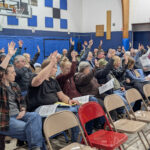
Dr. Molly Schauffer points out some interesting data during a lesson on March 6 during the MSSM science and engineering themed weekend.
This was the first science-and-math themed weekend, and it certainly made a splash.
Students had the option of attending both the climatological data lecture and vermicomposting lesson, or the windmill engineering activity.
Attendance was split between the two weekend options.
Luke Shorty, MSSM mathematics instructor, was in charge of coordinating the windmill testing/production; the concept of which began when Shorty began looking into what research is being done in the state of Maine that he could bring into his classroom so that the students would have an opportunity to apply their skills into real-world scenarios.
While on a field trip in South Portland, Shorty and his students listened to an interesting presentation [on the proposed offshore wind turbines in the Gulf of Maine] by Dr. Habib Dagher, director of the advanced structures and composites center at the University of Maine (UM).
After the presentation, Shorty asked Dr. Dagher what sort of math was being used in turbine development that Shorty would be able to incorporate into some of the beyond-calculus math courses offered at MSSM such as linear algebra and differential equations.
“I started looking into the research that they were doing and what they hoped to do and thought to myself ‘why don’t we just make a scale replica like they used to do with boats?’” Shorty explained.
Students were given a garbage bag containing about eight or nine pounds of steel, a PVC pipe that was five feet tall and three inches in diameter, washers, blades and some foam.
The final product was ten scale model turbines floating in the Limestone Community School/MSSM pool, waiting to be tested to see how they would fare in the Atlantic Ocean.
“A pool is nothing like the Atlantic, so the only way to model the Atlantic and to make sure the kids are having a good time is to get them in the water and make waves,” Shorty said.
Three out of 10 turbines survived mild waves, and only two out of 10 survived severe waves — which meant that the models had a 20 percent success rate and, judging by the students’ response to the activity, 100 percent educational enjoyment by the students.
What started as classroom curiosity and turned into a themed weekend will be followed up by an April 16 lecture that Dr. Dagher will be giving MSSM students at the UM campus.