

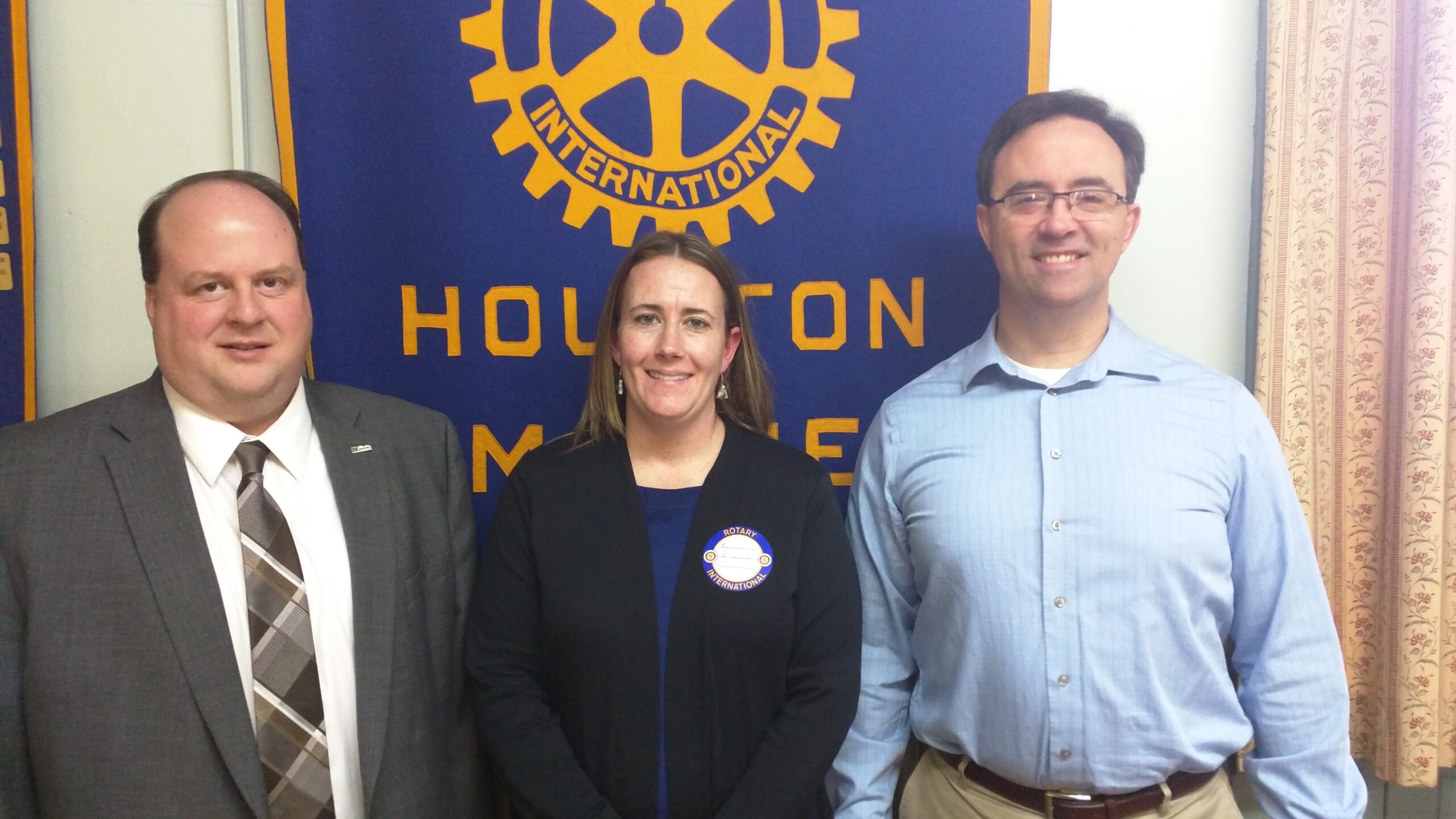
HOULTON, Maine — The Houlton Rotary Club met Dec.4 for its luncheon meeting. Erica Fitzpatrick Peabody was the guest of Rotarian Ellen Halliday. Peabody is married to Barrett Peabody and they have three children. She graduated from Houlton High in 1998.
Peabody graduated from the University of Maine with a degree in horticulture and she earned a master’s degree plant pathology. She worked as an agronomist at McCain’s for 12 years before joining her father on the Fitzpatrick family farm this year. The farm was founded in 1975 by Albert Fitzpatrick and he accumulated acreage in Houlton, Hodgdon and Linneus and now this is called the Fitzpatrick/Peabody Farm.
The potato industry is over 100 years old in Maine. These are now mostly multigenerational family farms with the exception of Pineland Farms Inc. There are over four hundred growers in Maine with over ninety percent of the potato acreage in Aroostook County. Annual sales in the State of Maine was five hundred and forty million dollars last year, with over thirty-two million dollars paid in state and local taxes.
Ten years ago there were 57,000 acres being farmed in Maine and today there are only 47,000 acres. Sixty-seven percent of the potatoes are processed for french fries, chips and other value added items. Twenty-two percent of the potatoes produced are seed potatoes while 11 percent are used for table stock. Forty-one percent of the potatoes are Russett Burbanks and these are good for french fries. Sixteen percent are the variety called Frito Lay for chip processing. Five percent are Red Norlands with another five percent being Russet Norkotah. A variety labeled Snowden totals four percent with the remaining 29 percent other varieties.
Maine harvests 32,000 pounds per acre on the average. Customers demand quality potatoes, a good fry color that is impacted by sugar levels, percentages of solids in the potato, a good shape, and no defects. The challenges involve yield, input costs (for example, electricity), imported Canadian potatoes, erratic weather, lack of profitable rotation crops, and diseases such as late blight. The strengths of the industry are being close to major markets, having fertile soil, producing a quality product, having people passionate about what they produce and the ability to dry-land farm as they are not dependent on other sources of water.
The advances seen today are that more irrigation is being used and that is up 15 to 20 percent from the past. There is a reduction in pesticide usage. GPS systems are now used for more precision planting. And molecular technology for disease testing is now widely used.
The Fitzpatrick/Peabody Farm raises french fry and chip stock and has their own trucking company to deliver to market. Technology now allows them to do soil fumigation to target soil borne diseases in the fall. It takes 500 years to form an inch of topsoil so it is crucial to constantly amend the soil.
Practices such as crop rotation, a covering of hay throughout the winter and planting green manure cover crops improve the soil.
The goal with growing new varieties is to improve yields and quality. The farm uses no genetic engineering. New storage buildings are managed to regulate temperature and humidity and maintain air quality. Carbon dioxide is used to keep sugar levels stable. Peabody predicts that the future of Maine farming will have an increase in farm size, more use of technology, and longer crop rotations. The focus will be to improve soil health.
-

- Captain Frank Nataluk, middle, of the Houlton Salvation Army accepts a check from Rotary President Matt Nightingale during a Dec. 3 Rotary meeting. With the two is Cadet Melissa Lowell of the Salvation Army. (Courtesy of Nate Bodenstab)