

CROSS LAKE, Maine — Out of more than 6,000 lakes in Maine, northern Aroostook’s Cross Lake is one of only 22 on the Maine Department of Environmental Protection’s impaired lakes priority list. Lake organizations, in an effort to minimize spread and better understand which lakes are having water quality issues, are seeking more volunteers.
Lake Stewards of Maine, a nonprofit focused on protecting Maine Lakes, will be hosting two volunteer training sessions in Aroostook County later this month. The first is set for Cross Lake on July 17 at 2 p.m., with the next set for July 18 at 11 a.m. on Nickerson Lake.
Aside from Cross Lake, the DEP list includes three other Aroostook lakes — Daigle Pond in New Canada, Monson Pond in Fort Fairfield and Trafton Lake in Limestone.
The list identifies lakes susceptible to nonpoint source pollution, which according to the Environmental Protection Agency is a form of pollution that can result from land runoff, rain, drainage seepage or changes to the water cycle. It is one of four Aroostook lakes on the list. This type of pollution can spread to connected lakes, but this could be prevented with more volunteers monitoring the water on more lakes.
Cheryl St. Peter, project manager for Friends of Cross Lake, a local nonprofit organization dedicated to protecting the lake’s water quality, said that both Cross Lake and Daigle Pond are in the St. John Valley’s Fish River chain of lakes. Both are on the list due to excess phosphorus.
Phosphorus is a plant nutrient, but it also has fueled algal blooms on Cross Lake. This is when the algae forms a thick mat or scum that covers part of a lake.
“If these problems are not addressed, the natural fish stocks will die off or cease to be present,” said Kirsten Thompson, an environmental specialist with the Maine DEP. “That means it’s not as enjoyable for fishing recreation.”
Thompson said the algae blooms contain toxins that can be fatal to pets, but added that there have been no confirmed pet fatalities in Maine resulting from algae. She said it is still important to make sure that any pets avoid algae, which accumulates on the shoreline as a greenish scum.
Excess algae can also hinder swimming and general recreation.
“It will be a beautiful day and you’ll want to go swimming, but the water will literally look like pea soup,” Thompson said.
Algae blooms are not permanent, but the frequency of blooms are measured in order to determine the severity of the underlying algae issue.
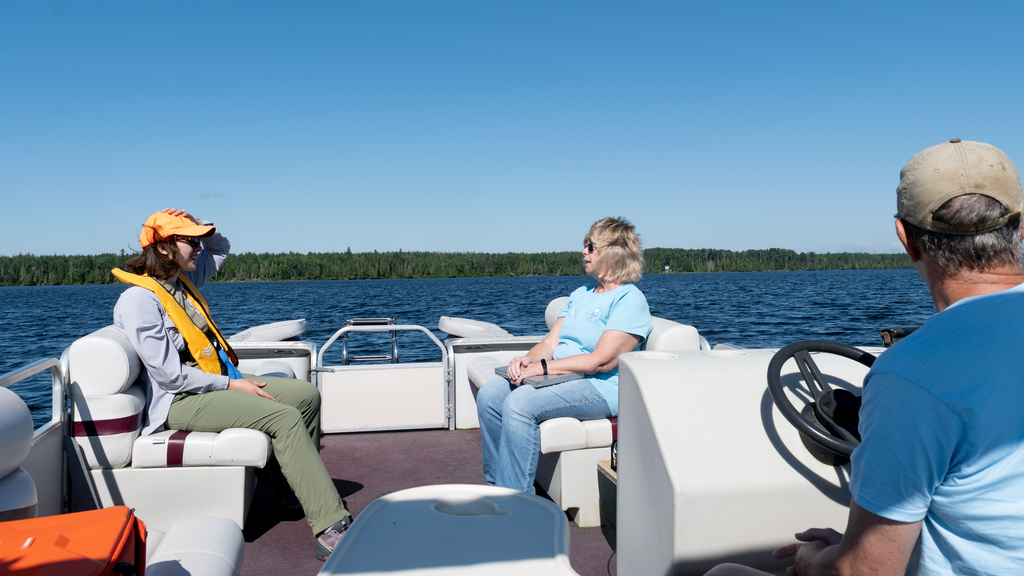
Volunteer monitoring work involves going out on the lake and using a Secchi disk to measure the water’s clarity. This disk, painted in an alternating black and white pattern, is submerged in the water and then viewed through an Aqua Scope. Volunteers will record the depth where the disc disappears and this information will be used to help determine the lake’s water quality.
Cheryl St. Peter and her husband Kirk St. Peter, who is president of the Friends of Cross Lake organization, said only a couple volunteers would be needed for each lake in the region.
“On our lake, for water quality monitors, it’s just me and Kirk, because you only need a couple people,” she said. “Except for Long Lake, which is pretty big, but if they did just one station they would still only need one or two people.”
Cheryl St. Peter said they are also looking for local volunteers to participate in the Maine Audubon’s annual loon count. Maine Audubon, an organization dedicated to conserving the state’s wildlife and environment, needs more loon counters in northern Maine for the numbers to be counted in its overall total. The loon count helps provide data on the state’s loon population over time.
Several lakes in the Fish River chain, including Mud Lake, Square Lake, Eagle Lake, and St. Froid, do not have any loon counters.
The annual loon count this year is on July 19 from 7 a.m. to 7:30 p.m.
Kirk St. Peter said they are also encouraging people on the lakes to avoid spreading zebra mussels.
“Zebra mussels are about the size of your little fingernail,” he said. “They grow on each other and they form clumps, and they get sharp.”
And while there are no zebra mussels in Cross Lake yet, Thompson said they have been detected nearby in Canada. The larvae are microscopic and can be introduced into new bodies of water from boats that move from lake to lake. The lake stewards advise boaters to “clean, drain and dry” their boats, trailers and survey gear for at least five days before moving to a new waterbody.
And for anyone out on the lake this summer, Thompson said it is good to steer clear of murky waters.
“If you’re out with kids or family and you come to any body of water, and you walk in with the water around your ankles and you can’t see your feet, don’t go swimming that day,” she said. “That’s basically the rule of thumb.”